

 0
0
 0
0
Greenpeace Australia Pacific has accused the Albanese Labor Government of “bleeding our country dry and burning it at the same time” by giving the green light to 1,695 new Queensland coal seam gas wells until 2081.
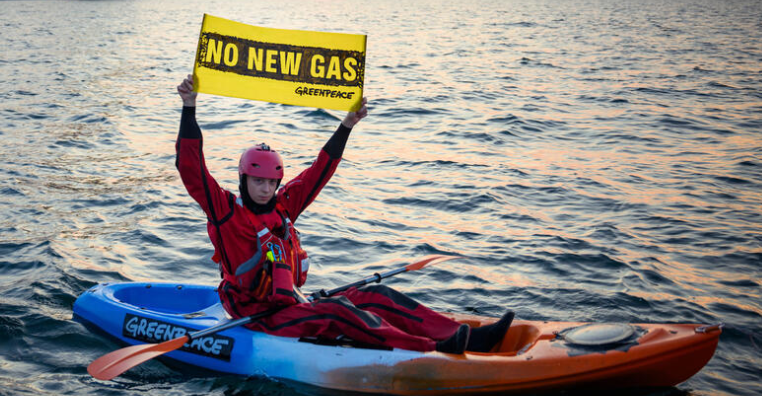
Greenpeace Australia Pacific media release
Greenpeace Australia Pacific has slammed the Federal Government’s decision to approve a massive gas expansion in Queensland, saying the decision prioritises corporate superprofits over our communities and climate.
The approval allows Australia Pacific LNG (APLNG), a joint venture between Origin Energy and multinational giants ConocoPhillips and Sinopec, to drill 1,695 new gas wells until 2081.
APLNG exports over 75% of their gas overseas for massive profit, while everyday people face soaring energy bills, and climate disasters like floods and fires.
This decision marks the 36th oil or gas approval by the Albanese Government since taking office in 2022. APLNG still requires approval from the Queensland Government for the project to move ahead.
Climate betrayal
Solaye Snider, Climate Campaigner at Greenpeace Australia Pacific, said: “This is first and foremost a betrayal of our climate, flying in the face of commitments Australia has made on the world stage to transition away from fossil fuels.
“This massive expansion serves only one purpose: deliver superprofits to greedy corporations like Origin Energy, ConocoPhillips and Sinopec who have an endless appetite for more gas. They are bleeding our country dry and burning it at the same time, with the green-light from the government.
“While the gas industry uses the war in Iran to scaremonger and price-gouge, distracting from the fact they are making superprofits from the windfall profits of war and paying barely any tax, the rest of the world is waking up to the fact that fossil fuels are the ultimate liability.”
Approval details
The Commonwealth Department of Climate Change, Environment, Energy and Water (DCCEEW) approved the Gas Supply Security Project, Surat and Bowen Basins, Queensland (EPBC 2020/8856) under the Environmental Protection and Biodiversity Conservation Act.
The approval gives APLNG permission to clear 64 hectares (ha) of Brigalow Threatened Ecological Community, 106 ha of Poplar Box Grassy Woodlands Threatened Ecological Community, 146 ha of Australian Painted Snipe foraging habitat, 428 ha of Greater Glider habitat, 853 ha of Koala habitat, 10 ha of Ornamental Snake habitat, and 19 ha of Ooline habitat.
The applicant is forbidden from clearing any Coolibah-Black Box Woodlands of the Darling Riverine Plains and the Brigalow Belt South bioregions Threatened Ecological Community, Ooline individual, semi-evergreen vine thicket of the Brigalow Belt TEC, Weeping Myall Woodlands TEC, Community of native species dependent on natural discharge of groundwater from the Great Artesian Basin, Salt pipewort individual, Curly-bark wattle individual, Shiny-leaved ironbark individual, Tara Wattle individual in particular areas, Belson’s Panic individual in particular areas, Austral Toadflax individual in particular areas, Bertya opponens individual, Red Goshawk nest tree, Australian Painted Snipe breeding habitat, Large-eared pied bat (active and nonactive) roosting and breeding habitat, White-throated Snapping Turtle habitat, Fitzroy River Turtle habitat during the Fitzroy River Turtle breeding and hatchling season, Brigalow Woodland Snail habitat in particular areas and Dulacca Woodland Snail habitat in particular areas, or Xerothamnella herbacea individual.
There are also restrictions on how close to particular species or habitat areas the proponent can clear such as “the approval holder must not clear within: 30 metres (m) of any Shiny-leaved ironbark individual or 100 m of any Red Goshawk nest tree…”
“If the approval holder detects the presence of any protected matter or the habitat of a protected matter within the Action area that was not previously reported [they]… must notify the department in writing of its detection within 10 business days. The approval holder must notify the department in writing of the likely extent of the protected matter or area of habitat within 60 business days following detection.”
Other measures have been put in place to avoid and mitigate harm to habitat and threatened species such as Environmental Constraints Planning and a Field Development Protocol. Before starting to clear land for petroleum-related activities, the proponent will be required to do some “ground truthing” – that’s physically looking for signs of listed threatened species and their habitat.
Offsetting will also be required to make amends for the destruction of habitat and species permitted under the EPBC approval. There will be an environmental management plan in place throughout the project and a rehabilitation management plan.
“The approval holder must re-establish all Fitzroy River Turtle habitat (including any watercourse bed or bank) disturbed as part of the Action to pre-disturbance condition,” the EPBC consent document states, clearly indicating such disturbance is expected.
A baseline subsidence assessment is also required under the Commonwealth approval.
The proponent does, however, have 20 days to report to the Commonwealth Department any impacts on EPBC-protected springs in what is known as the Surat Cumulative Management Area.
Toxic chemicals
According to Greenpeace Australia Pacific, the value of Australia’s coal and gas exports is predicted to plummet by 50% over the next five years as global demand for fossil fuel falls, according to Treasury modelling.
The approval also requires APLNG to maintain a public Register of Assessed Chemicals — including drilling chemicals assessed for toxicity and persistence in the environment — because the government recognised these chemicals pose a risk to groundwater and protected species.
“The truth is, we don’t need to drill for more polluting dirty gas. We already have enough gas in Australia to support the transition to cheaper, cleaner energy without locking in more harm.
“The Australian government needs to wake up and realise there is no future in fossil fuels. Australia’s economic future is in clean energy and green industries. The longer we delay that reality, the further we will be left behind.”
Numbers game
Whilst Greenpeace points to the superprofits to be generated from the project, the estimated gross profit over the 50-year life of the project would be around $13 to $14 billion (Aus).
That’s $280 million per year before the Australian Government’s Safeguard Mechanism requires the project to offset a portion of its estimated 111 million tonnes of lifecycle CO2 emissions, which could cost hundreds of millions in carbon credits.
Any increase in the “Domestic Gas Reservation” (currently proposed at 15–25%) would force more gas into the lower-priced Australian market, reducing the overall profit margin.
If global demand for gas drops significantly before 2081 due to electrification, these wells may become “stranded assets,” ending production earlier than the permitted date.
Will the destruction of habitat and loss of threatened species be worth the profits?
WHAT YOU CAN DO
If you are concerned about the Commonwealth Government’s ongoing approval of gas and coal projects:
- Speak to your local federal MP by sending them an email or asking for an appointment.
- Consider expressing your concerns to the relevant minister, in this case, Tania Plibersek or writing to the Prime Minister, Anthony Albanese.
- For more information about Greenpeace Australia Pacific visit the Greenpeace website.