
 0
0
 0
0
The NSW Government recently declared it would not permit any new coal mines in the state but that didn’t stop the Independent Planning Commission (IPC) from approving a two-year extension of the Chain Valley underground and underwater coal mine at Lake Macquarie.
By Jacquelene Pearson*
The NSW Independent Planning Commission’s decision to approve Delta’s proposal to extend the life of its Chain Valley and Mannering collieries was made within weeks of the NSW Minns Government declaring there would be no new coal mines approved in NSW and on the same day the sentencing of Delta for a mass fish kill in Lake Macquarie in 2022 was considered in the NSW Land and Environment Court.
The fish kill sentence hearing is now expected to happen in August.
The coal mine expansion matter was referred to the IPC by the NSW Planning Minister on 16 December 2025. Originally exhibited in 2022, it took the Minister for Planning until December 2025 to refer to the IPC because the public had made over 130 objections to the proposal.
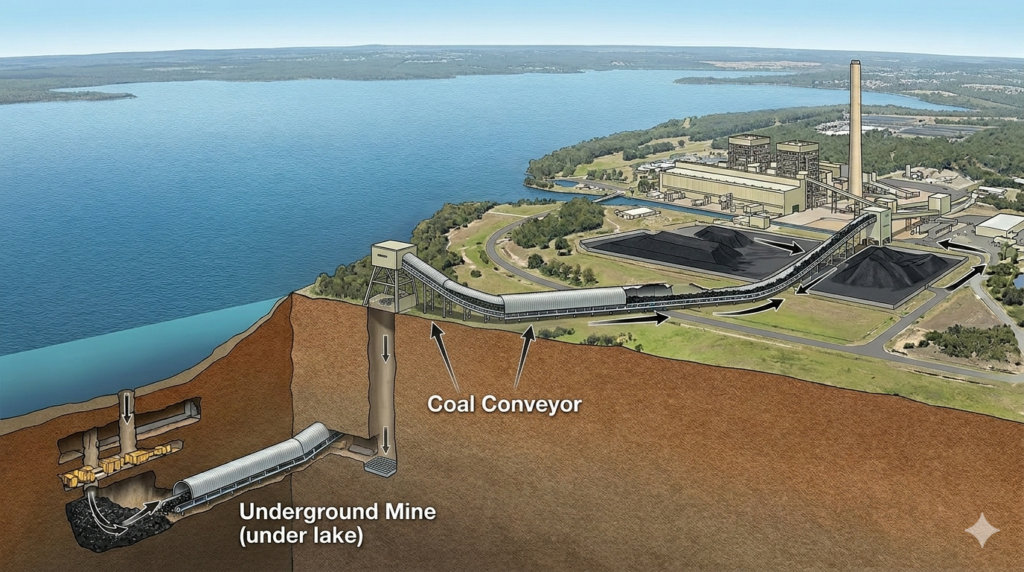
The Chain Valley and Mannering collieries already operate as a single entity providing coal to Delta’s Vales Point Power Station via conveyor but the proposal will consolidate the two operations under a single and ‘modernised’ consent.
Whilst not strictly a new mine, the IPC decision will extend the life of the mine by two years and will result in the extraction of an additional 2.8 million tonnes of coal per annum.
The two-year extension was meant to align with the 2029 closure date of Vales Point. However, the Minns government has now pushed that out to 2033. It is not clear how VPPS will acquire its coal and stay economically viable from 2029 to 2033.
The IPC received over 200 public submissions, held a public hearing and called for submissions again following the NSW Government’s release of its NSW Coal Industry 2026-2050 policy statement, garnering another 79 submissions.
Agencies agree
The IPC notes early in its Statement of Reasons for Decision that a whole-of-government assessment was undertaken by the NSW Department of Planning in consultation with 11 agencies, including the Environmental Protection Authority (EPA), and the Department of Climate Change, Environment, Energy and Water and “none objected to the application”.
According to a Central Coast and Lake Macquarie based charity, Future Sooner, that makes the EPA complicit in providing Delta with a “licence to poison” Lake Macquarie.
“The NSW IPC has approved the expansion of Delta’s Chain Valley coal mine – ignoring community concerns and excessive methane emissions – and the EPA along with 11 other NSW Government agencies and their ministers are complicit,” says Future Sooner’s Chair, Gary Blaschke OAM.
“Delta was successfully prosecuted by the Environmental Protection Authority (EPA) for the company’s Vales Point coal-fired power station poisoning Lake Macquarie and causing a massive fish kill in 2022.
“Future Sooner congratulated the EPA when it achieved the conviction of Delta, a company that has continuously breached its environmental protection licence conditions.
“That guilty verdict was handed down in December 2025. Cut to April 2026 and suddenly the EPA supports expanding Delta’s Chain Valley mines that will further poison the lake. Not only with CO2 but also with lethal methane.
“When Delta was asked, at a recent IPC public hearing regarding its coal mine expansion application, what plans it had to stop methane escaping into the air and the lake, it admitted to having no plans.
“What happened between December and April to turn this state’s ‘environmental protection’ authority into a pro-poison authority – from prosecuting to advocating for the poisoner?
“The EPA has all the information about the life-threatening health issues residents suffer from the polluting Vales Point power station.
Future Sooner said it was “horrifying” that 11 agencies, including the EPA and both the Central Coast and Lake Macquarie Councils did not object to the Delta proposal.[1]
“The IPC completely ignored all the community submissions pleading to reject the application in the hope that the government would consider the welfare of its citizens’ health and wellbeing over the avarice of Delta’s Czechoslovakian billionaire owner.”
Serving the public interest?
The IPC’s reasons for approving the extension of the mine cite public interest via the ongoing supply of coal to the Vales Point Power Station to provide base load power while NSW transitions to renewables.
However, the NSW Nature Conservation Council reported that, according to Reliability Watch, Vales Point Unit 5 was offline for more than 4000 hours over the summer of 2025-26.
Reliability Watch ‘failures and breakdowns’ data shows that Vales Point 5 has been offline twice already this year (both in February resulting in 600KWH being unavailable both times) and Vales Point 6 has had one such incident.
Like many aging coal plants, Vales Point has faced increased maintenance requirements including the Reliability Watch reports of significant unplanned outages, highlighting the difficulty of relying on 50-year-old units for consistent base load.
It traditionally contributes about 10% of the state’s energy needs but as more solar and energy storage systems come online its base load role continues to be diminished.
In fact, even when running at half its full capacity, there is convincing evidence that VPPS is not needed for base load security and, therefore, the additional coal is also not needed.
No longer needed
During the public hearing John Shiel PhD provided evidence that Vales Point Power Station and the collieries are no longer needed for the National Energy Market’s (NEM’s) energy security because “the total solar power that is installed and generated every year since 2024 provides more power than the VPPS’ss reliable supply and more power than that needed for the next five years in the NEM.”
According to Dr Shiel, “Vales Point has no need to operate past 2028 since solar alone replaces its generation.”
Shiel also argued at the public hearing that “if all the unemployed and everyone in the mining and coal-fired electricity industries were employed in the renewables industry there would still not be enough workers for the Million Job plan”.
In other words, the public interest arguments put forward by the IPC that the coal is needed for base power security and job security in NSW, are spurious, according to Dr Shiel.
Tighter transport conditions
The IPC has taken away Delta’s flexibility to transport coal to other domestic customers or for export by tightening its capacity to transport coal on public roads. and that is a small concession in light of the any problems with the proposal highlighted by the public and stakeholders.
The original conditions of consent, put together by the Department of Planning before the IPC’s call for submissions or public hearing, allowed the substantial haulage of coal by private and public road
It is clear that concerns expressed by the community about road transport of coal prompted the IPC tighten those conditions.
In correspondence between the IPC and the Department of Planning dated late March, the IPC asked for advice on the following restriction: “A maximum of 1.5 million tonnes of product coal may be transported by truck from the site to VPPS via private roads in any calendar year if the conveyor cannot be used.”
The Department of Planning recommended that the IPC should seek the proponent’s advice in case there were other reasons (apart from the conveyor not working) to use private roads. The IPC appears to have ignored this advice.
The IPC’s new conditions of consent still allow a maximum of 1.5 million tonnes of coal to be transported by truck from the mine to Vales Point Power Station on private roads if the conveyor can’t be used. The truck movements would need to occur between 5.30am and 10pm.
The IPC has also permitted coal to be transported on public roads in an “emergency” and with the permission of Planning Secretary who can impose conditions. No definition of an emergency is given.
The new consent conditions struck out the ability of the proponent to truck 660,000 tonnes of coal by truck to the Port of Newcastle for export and another 180,000 tonnes of coal via truck to domestic customers other than Vales Point – both would’ve been allowed on public roads.
The commission concluded that the transport by truck of coal to other customers would “increase amenity impacts for communities along the along the transport route – including additional noise and dust impacts and contribute to traffic congestion, elevated safety risks and result in higher Scope 1 emissions”.
It’s a small win for the community but there’s no definition of what an emergency might be – could it be the conveyor being out of service for prolonged periods of time, for instance.
And there does not appear to be provision for what will happen to coal brought to the surface if Vales Point is not operating at its projected capacity. There can be no stock piling of coal extracted at Chain Valley.
Health risks dismissed as ‘manageable’
Whilst the IPC’s main justification for approving the mine expansion appears to be economic – job security and base load power security, it has ignored both the inherent and substantial public health and environmental risks tha come with the mine expansion.
Again, John Shiel summed this up neatly during the public hearing.
“Vales Point Power Station is one of Australia’s worst polluting stations,” he said. “It has no modern air filter on chimneys causing many health issues due to fine particulate PM2.5 cancerous emissions and Nitrogen Oxides and Sulphur Dioxide emissions.”
According to Dr Shiel, the NSW EPA ignored the World Health Organisation PM2.5 guidelines of an annual mean of 5 Ug/m3 for long-term exposure and 15ug/m3 24-hour mean for short-term exposure to reduce acute health impacts.
“There is no safe level of PM2.5 particulates,” he said. “Vales Point Power Station is one of few power stations in the world given an EPA licence exemption to pollute (PM2.5, Nitrates, Sulphates etc) at the expense of the health of locals (asthma, cancers),” he said.
The World Health Organisation states that harm occurs even below its guideline values. Shiel’s provided a graphic representation of PM2.5 particulates measured at the Wyee Air Quality Monitoring Station through 2024 which demonstrated regular excedences of the WHO maximum level.
Perhaps that explains the disturbing cancer data and ghost wipe results found in populatiosn living near power stations that Future Sooner has been highlighting since 2024.
The IPC did not consider the PM2.5 health risks associated with the combustion of the coal at the power station, focusing only on the small levels of particulate matter produced during mining.
Emissions ignored
The IPC has said its consent is consistent with the NSW decarbonisation pathway and concluded that the negative greenhouse gas impacts are outweighed by the benefits of providing base load power.
It has argued that because the project will cease before the NSW Government’s 2030 emission reduction targets, those targets don’t need to apply to the project.
The IPC requires Delta to provide a Greenhouse Gas Mitigation Plan outlining how it will mitigate Scope 1 and 2 emissions.
Delta will not be required to do anything about Scope 3 emissions. According to the IPC, “As all of Scope 3 emissions for the project will be accounted for and regulated by the Commonwealth’s Clean Energy Regulator as part of the Scope 1 emissions for Vales Point Power Station, the Commission has not imposed specific conditions regulating the Scope 3 emissions of the project.
“The Scope 3 emissions, arising from the project, as amended by the conditions of consent, will all occur in NSW and, therefor, be regulated under – among other controls – the safeguard mechanism as it applies to VPPS and the VPPS Environmental Protection Licence (EPL).”
According to Dr Shiel, the Scope 3 CO2-e emissions will equal 23Mt CO2-e for the total coal to be burned at Vales Point.
It appears that the IPC is having its cake and eating it too by excusing Delta from responsibility for Scope 3 emissions from the mines, instead stating those emissions are dealt with via requirements on the power station.
The IPC made it clear it could not consider the human health impacts of VPPS as part of its deliberations on the Delta coal mine extension but then, ironically, offloaded the Scope 3 emissions from the mine to the power station.
The impact
Even if it is acceptable to ignore the Stage 3 emissions related to the coal mine, Dr Shiel, and many other community witnesses and submitters, made the point that continuing to burn coal will make it impossible to meet the 2015 Paris COP21 commitment to keep temperatures below 2 degrees C.
“Temperatures are increasing alarmingly, risking tumbling beyond ‘hothouse earth’ tipping points,” Dr Sheil said. “Exreme events are getting more frequent, of longer duration and more intense. This is because there is more energy in the atmosphere and each degree of extra heat means air can contain 7% more water vapour.”
Fugitive Methane is a major problem at the Chain Valley and Mannering collieries and it is has not been addressed by Delta. John Shiel said the fugitive methane needs independent monitoring.
“The 20-year Global Warming Potential, which is close to 86 times that of CO2 needs to be used for methane emissions because we don’t have 100 years to keep temperatures below 2 degrees C,” he said.
And then there’s what happens when the mine and the power station are finally closed down.
The massive ash dam at Doyalson will require full remediation and, as noted by Dr Shiel, “The owners of Vales Point Power Station and Delta Coal (7GI) have a poor environmental record globally.”
In Australia it has been found guilty of the 2022 Lake Macquarie Fish Kill, attributable to basic maintenance failures at VPPS.
“In the US there are legal actions involving its Blackhawk mines that show a pattern of legal and community conflict around its coal operations. In the Czech Republic a complaint has been lodged with the European Commission regarding breaches of the Industrial Emissions Directive.
“How can the community be onfident that 7GI will remediate all the VPPS waste fly ash generated since 2016? This did not feature in the state government recommendations,” Dr Shiel said.
“Why should more mine voids be created under Lake Macquarie to eventually cause a larger settlement area of the bottom of the lake?”
Inconsistencies
Future Sooner is considering referring the IPC’s determination to the NSW Ombudsman on the basis of problems with the process it followed in this case including the provision of inconsistent and contradictory public information.
Future Sooner president, Gary Blaschke OAM, was called to order during the public hearing for criticising the NSW Planning Department’s publication of conditions of consent that implied the IPC had already given its permission for the colliery extension to go ahead even before considering submissions or holding a public hearing.
Mr Blaschke was told during the hearing that the consent conditions were “drafts” even though that word was not used on the document available on the IPC website.
A closing statement by the committee chair, Professor Neal Menzies AM, at the public hearing also appeared to pre-empt the consent: “And the other thing that I stressed at the outset, which is please don’t assume that we will reject this. If you want it rejected and you’ve got ideas that would make it better, have a bet each way. So, give us those thoughts as to what could make the conditions that we apply work better.”
Whilst the colliery has been granted an extension to 31 December 2028, the conditions of consent appear to last for five years from commencement. This is a bit of a loophole Future Sooner says it will be watching closely. Could a delayed commencement see the closure of the mine pushed more in line with the VPPS closing date?
*Jacquelene Pearson is the publisher of The Point ESG News Site and voluntary secretary of Future Sooner
[1] 4.17 Pg 5: IPC Report – Chain Valley Colliery Consolidation Project SSD-17017460 , Statement of Reasons for Decision.