

 0
0
 0
0
The UK’s long tradition of pioneering social innovation reached a new milestone earlier this year with the formal activation of the Better Futures Fund (BFF).
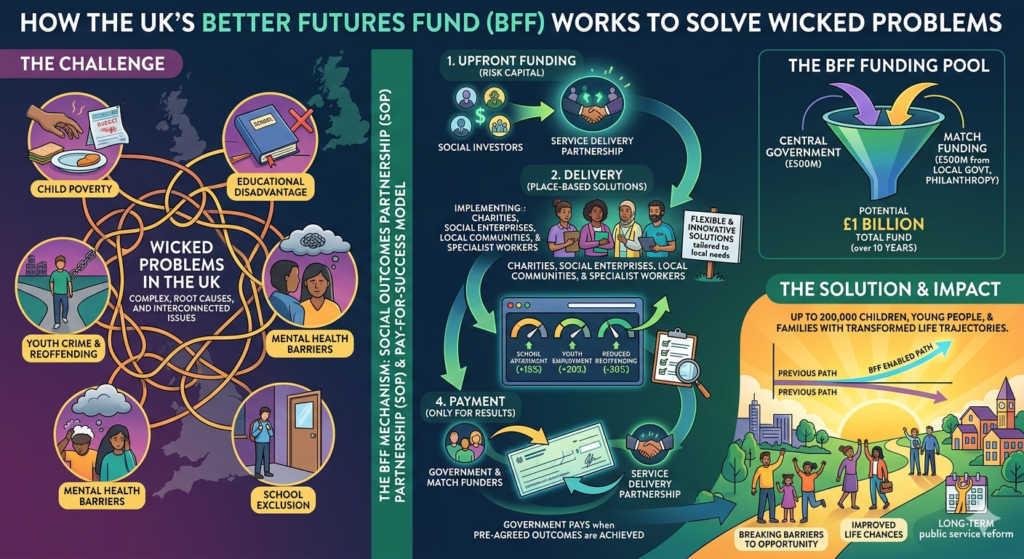
Various sources*
Representing a £500 million central government investment, and aiming for a total catalytic impact of £1 billion, the BFF is not merely a grants program.
It is a structural overhaul of how the UK government addresses the most “wicked” social problems, primarily child poverty and youth marginalisation.
As of May 2026, the fund is moving from its design phase into its first active delivery round.
To understand its significance, one must look at the intersection of public policy, social finance, and the evolving philosophy of the British welfare state.
Structure and history
The BFF did not emerge from a vacuum – it is the direct successor to the Life Chances Fund (LCF), which operated from 2016 to 2025.
The LCF was a £70 million experiment that supported 29 projects so the BFF represents a massive scale-up in both capital and ambition.
The history of the BFF is rooted in the development of Social Impact Bonds (SIBs), a concept first launched in Peterborough in 2010 to reduce prisoner reoffending.
Over the following 15 years, the UK launched more than 100 such partnerships.
By 2024, the Department for Culture, Media and Sport (DCMS) and the Government Outcomes Lab (GO Lab) at the University of Oxford began synthesizing a decade of data to design a “permanent” fixture in the UK’s social infrastructure.
The result was the BFF, announced in late 2025 and formally opened for delivery partner applications in April 2026.
Administrative structure
The fund is managed by the Department for Culture, Media and Sport (DCMS), working in close collaboration with the Treasury and the Department for Education.
Structurally, it operates through a “hub-and-spoke” model:
- The Hub: A central Delivery Partner (a competition for which is currently underway as of May 2026) oversees the technical distribution of funds, rigorous evidence gathering, and performance management.
- The Spokes: Local authorities, combined authorities (such as the Greater Manchester Combined Authority), and regional commissioners who lead the “Social Outcomes Partnerships” (SOPs) on the ground.
Aims and objectives
The BFF is defined by a 10-year lifecycle (2026–2036) – an intentional long-term horizon designed to move away from the “short-termism” that often plagues government spending cycles.
Core objectives are:
- Tackling child poverty: the overarching goal is to support up to 200,000 children and families living in relative poverty. The fund seeks to address the “structural and root causes” rather than just providing temporary relief.
- Improving life chances: specific targets include measurable improvements in school attainment, reducing youth reoffending, and increasing stable youth employment.
- Public service reform: the BFF aims to shift the “commissioning culture” of the UK by moving from “fee-for-service” (where the government pays for an activity, like a training course) to “outcomes-based” (where the government pays for a result, like a person getting a job).
- Market diversification: it aims to grow the “impact economy,” encouraging more charities and social enterprises to enter the market and attracting new social investors.
Funding sources
The BFF uses a “blended finance” model. While the headline figure is £500 million from the central government, the fund is structured to double that amount through three primary streams:
I.Central government “top-up” (£500m): the DCMS provides the core capital but this money is rarely paid out upfront. Instead, it is held in a “top-up” fund. When a local project achieves a verified result (eg a teenager stays in school for a full year), the BFF pays out a portion of the “outcome payment.” On average, the BFF covers 50% of the cost of these outcomes, a significant increase from the 35% average provided by the LCF.
II. Local and philanthropic match funding (£500m target): to access the BFF, local commissioners (such as City Councils) must provide match funding. This ensures “skin in the game” at the local level. Additionally, the BFF actively solicits contributions from major philanthropic foundations that want to see their capital used to trigger government-level systemic change.
III. Social investment (upfront working capital): perhaps the most distinct feature is the role of social investors. Because charities and social enterprises often lack the cash reserves to run a program for years before being paid by the government, social investors provide the “upfront capital.” These investors take on the financial risk: if the program fails to deliver results, the government pays nothing, and the investor loses their money. If the program succeeds, the government pays the charity, which then repays the investor with a modest return.
How the money is invested
The BFF does not “invest” in the traditional stock market sense. Instead, it “buys outcomes.” The investment process is highly localized and data-driven.
The commissioning process consists of:
- Identification: a local authority identifies a specific problem (eg high rates of school exclusion in a specific borough).
- Metric design: they define exactly what a “win” looks like (eg a 20% reduction in exclusions over three years).
- Partnership formation: a Social Outcomes Partnership (SOP) is formed, bringing together a service provider (often a local charity), a social investor (like Better Society Capital), and the BFF.
- The contract: A “pay-for-success” contract is signed.
Sector focus
While the fund is flexible, the investment strategy for Round 1 (Summer 2026) is heavily weighted toward:
- Education and skills: intensive mentoring for at-risk pupils.
- Youth Justice: diversionary programs to keep young people out of the criminal justice system.
- Health and wellbeing: early intervention for mental health issues that lead to family breakdown.
How the money is used
The actual “use” of the money on the ground is where the BFF’s flexibility shines.
Unlike rigid government grants that dictate exactly how many staff to hire or what curriculum to use, the BFF focuses on the end result.
This gives service providers the “freedom to fail and adapt.”
Because the service providers are paid for the outcome, they can pivot their methods if they realise a certain approach isn’t working.
For example, if a “youth employment” project finds that lack of transport is the biggest barrier to work, they can use their funding to provide bus passes or electric bikes, even if that wasn’t in the original “service plan.”
The funding for Round 1 is profiled across the decade to ensure sustainability:
- Years 1–3 (£8.45m): focused on “ready-to-go” projects and setting up the evidence-gathering infrastructure.
- Years 4–6 (£15.3m): scaling up successful models.
- Years 7–10 (£16.03m): long-term payments for multi-year outcomes and final evaluations.
A high-stakes bet on the future?
The BFF represents a gamble that accountability and flexibility can solve problems that decades of top-down spending could not.
By shifting the financial risk from the taxpayer to social investors and tying every pound to a life changed, the UK is attempting to build a “smarter” safety net.
The success of the BFF will be measured not just by the £1 billion deployed, but by the 200,000 lives it aims to stabilise.
It is a bold acknowledgment that in the modern era, “better futures” aren’t bought with promises, but with proven results.
Drop us a line
Send us an email about how you think a system like this could work in Australia. Often these wicked social problems get flicked to the states and territories in Australia. Would a national fund work?
Do you think this outcomes-based model, where investors take the risk instead of the taxpayer, is the most effective way to handle social issues, or does it risk turning social care into a “numbers game”?
*Sources
- GOV.UK: “Better Futures Fund – Guidance” (Published Jan 2026, Updated April 30, 2026).
- Department for Culture, Media and Sport (DCMS): “Better Futures Fund: Delivery Partner Round 1 Competition Guidance” (April 2026).
- UK Fundraising: “UK government seeks delivery partner for £500mn Better Futures Fund” (Published May 6, 2026).
- Government Outcomes Lab (GO Lab), University of Oxford: “Social Outcomes Partnerships and the Better Futures Fund” (March 2026 Research Brief).
- SES Water: “Better Futures Fund – Community Impact Report” (Referenced for historical naming context).
- London.gov.uk: “Greater London Authority Better Futures Cleantech Program” (Referenced for name differentiation).