
 0
0
 0
0
The future of the United Nations was under scrutiny at the Women Deliver 2026 conference in Melbourne recently, and the push is on for the next UN General Secretary to be a woman.
By Jacquelene Pearson
When some of the world’s most influential women tell you that we live in a time of acute illiberalism and authoritarianism, escalating conflict and a global backlash attacking the lives, livelihoods and bodies of women, girls and gender diverse people, the sense of urgency is undeniable.
Overlay that with a worsening climate crisis, and it is easy to conclude that it is time for a significant global power shift.
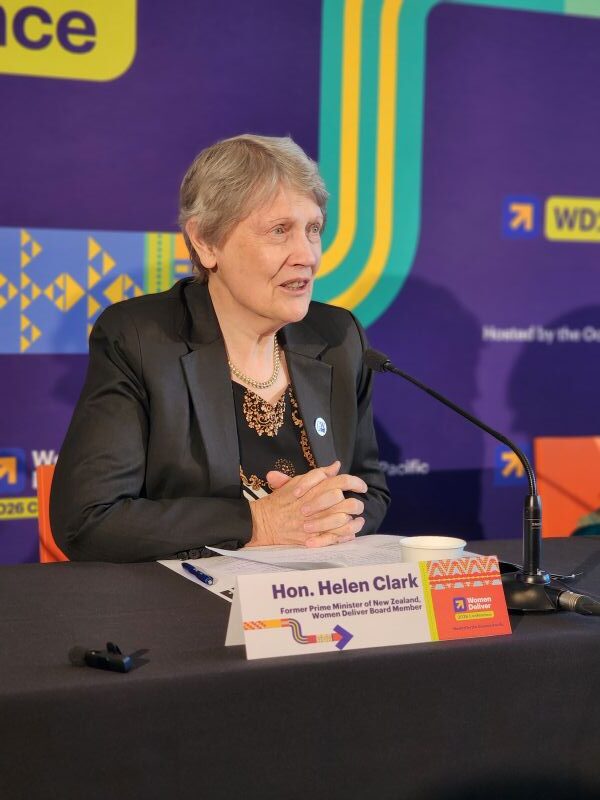
Former New Zealand Prime Minister Dr Helen Clark’s opening remarks at the recent Women Deliver 2026 conference in Melbourne were clear on the topic of power – it needs to shift from the top of the United Nations down.
Whilst acknowledging that States (national governments) must continue to be held to account, Clark said that it was increasingly challenging as civil society is undermined by unjust patriarchal systems.
It was noted that, whilst there are 219 women in positions of leadership within the UN hierarchy, representing over half of the planet’s population, the UN has never had a woman as Secretary-General.
Clear need for change
In addressing the media at Women Deliver, Helen Clark said the need for change at the top might be clear, but it will not be easy to achieve.
“We are facing many disturbing trends,” she said, alluding to an abandonment of international rules in favour of “might is right”.
“International humanitarian law is routinely being abused,” she said. Categorically stating that the geopolitical state of play was “rather a gangland”.
She said we are seeing “erosion in allegedly democratic societies”, but “we have to stand and fight for the rights of free expression.”
Clark remarked on the clear difference between the United Nations member states and what she referred to as the “UN of the many organisations”.
She did not hold back when describing some of the poorest behaviours of the dominant nation states: the United States, she remarked, had been involved in 100 regime changes since World War Two.
December deadline
Clark is leading an active, strategic geopolitical campaign to select the first-ever female United Nations Secretary-General. She has been the driving force behind the movement, along with global advocacy groups and civil society networks.
The timeframe for success is short. Clark wants a woman to succeed António Guterres when his term expires on December 31, 2026.
Helen Clark’s motivation for pushing to break the UN’s highest glass ceiling stems from extensive firsthand experience within the organisation. She was the first woman to lead the United Nations Development Program (UNDP) for two terms from 2009 to 2017.
Clark ran for UN Secretary-General herself in 2016. Despite being widely regarded as one of the most qualified candidates, she faced the traditional, closed-door geopolitics of the UN Security Council, which ultimately selected António Guterres.
“We had 13 candidates that time, but we are having another go this time,” she told Women Deliver. “It would be transformative in itself as women are much more likely to be the peacemakers,” she told the conference.
“We are encouraging a field,” she said.
Since 2016, she has focused on systemic reform, working with networks like the Council of Women World Leaders and Women Political Leaders (WPL).
She has lobbied member states to formalise transparent selection processes and for women to be nominated based on their competence as leaders.
According to Helen Clark, the UN can’t advocate for global gender equality while failing to reflect it at the top.
Campaign and candidates
The push is supported by the Campaign to Elect a Woman UN Secretary-General (WomanSG), a coalition that’s working on shifting the selection process from an old-school “smoke-filled room” to a more transparent public forum.
They advocate for two principles:
- Gender equality: in 81 years and across nine Secretaries-General, a woman has never held the post.
- Regional rotation: the Americas haven’t held the post since Peru’s Javier Pérez de Cuéllar (1982–1991), so there is a strong consensus that it is the turn of the Latin American and Caribbean (GRULAC) region.
The official selection process for the 10th Secretary-General opened late last year, and public “interactive dialogues” (televised debates/questioning by member states) occurred in April.
The field features powerful female contenders, primarily from Latin America:
| Michelle Bachelet | Chile | Two-term President of Chile; UN High Commissioner for Human Rights; Executive Director of UN Women. | Supported by Brazil and Mexico (Chile initially nominated but later withdrew it due to domestic political shifts). |
| Rebeca Grynspan | Costa Rica | Secretary-General of UNCTAD; former Vice President of Costa Rica; former Associate Administrator of the UNDP. | Nominated by Costa Rica. |
| María Fernanda Espinosa | Ecuador | Former President of the UN General Assembly; former Foreign Minister and Defense Minister of Ecuador. | Nominated by Antigua and Barbuda. |
Big hurdles ahead
Male candidates are also in the race, including Rafael Mariano Grossi of Argentina, the current head of the IAEA, and Macky Sall, the former President of Senegal.
The ultimate choice still relies on the traditional mechanics of the UN Charter. The 15-member Security Council votes behind closed doors using “straw polls.”
To secure the nomination, a candidate must win a majority of votes and avoid a veto from any of the Permanent Five (P5) members: the US, UK, France, China, and Russia.
As of June 2026, candidates like Michelle Bachelet are engaging in high-level diplomacy with P5 capitals, such as recent bilateral meetings in Beijing, to secure consensus.
The Security Council will begin its closed-door deliberations in late July, with a final recommendation expected between August and October, ahead of the General Assembly’s formal appointment for the term starting January 1, 2027.
Clear paradox
The mechanics of selecting the UN Secretary-General reflect a clear governance paradox. The UN General Assembly represents 193 nations, but the choice of Secretary-General is dictated by the narrowest of gatekeepers – the Security Council and ultimately the P5 veto power.
Historic P5 veto voting patterns are likely to combine with current geopolitical flashpoints to shape the selection process this year.
The UN Charter says the Secretary-General is appointed by the General Assembly upon the recommendation of the Security Council.
That recommendation is subject to the veto power of the P5, and that has traditionally meant that candidates who are outspoken, independent or dynamic are usually rejected via a P5 veto. A compromise candidate who will not rock the status quo is usually victorious.
In 1996, the United States vetoed a second term for Boutros Boutros-Ghali due to his independent streak and disagreements over peacekeeping operations.
In 2016, highly qualified candidates like Helen Clark and Irina Bokova were rejected early in the straw polls due to P5 preferences, clearing the path for António Guterres as the consensus choice.
Tricky timing
It’s no surprise that the UN Security Council is particularly fragmented this year. P5 fractures are the deepest they’ve been since the Cold War due to the wars in Ukraine, the Middle East and tensions in the Indo-Pacific. Those fractures are likely to impact the five official candidates:
Michelle Bachelet (Chile): Former two-term President of Chile and UN High Commissioner for Human Rights. She is highly qualified, but her tenure as Human Rights Chief is a veto risk. Her 2022 report on potential crimes against humanity in Xinjiang angered China. She was initially nominated jointly by Brazil, Mexico, and Chile under a leftist government. Chile has since withdrawn its home country’s backing.
Rafael Grossi (Argentina): Current Director General of the International Atomic Energy Agency (IAEA). Grossi has extensive technical and diplomatic experience, but his work at the IAEA has placed him in the middle of highly political nuclear standoffs. His stance on Iran’s nuclear program and monitoring at Ukraine’s Russian-occupied Zaporizhzhia nuclear plant make him a target for a Russian veto.
Rebeca Grynspan (Costa Rica): Current Secretary-General of the UN Conference on Trade and Development (UNCTAD) and former Vice President of Costa Rica. Grynspan is seen as a possible consensus candidate. Her leadership at UNCTAD has focused on Global South development issues, which appeals to China and Russia. Her alignment with traditional Latin American diplomacy makes her acceptable to the United States and France.
María Fernanda Espinosa (Ecuador): Former President of the UN General Assembly and former Foreign Minister of Ecuador. Backed by Antigua and Barbuda, she has strong ties across the Latin American and Caribbean Group (GRULAC). She is a well-known multilateralist, but navigating the ideological divisions between the US and Russia/Bejing will require intense behind-the-scenes diplomacy.
Macky Sall (Senegal): Former President of Senegal and former Chairperson of the African Union. Nominated by Burundi, Sall is the outlier to the regional rotation, which favours Latin America. An African candidate faces an uphill battle because Africa held the post under Kofi Annan from 1997 to 2006.
Timeline
The selection process is now in the hands of the Security Council, which will begin its closed-door discussions in late July. Between August and October, colour-coded straw polls will be used to eliminate controversial candidates.
No matter how smart and hard the women’s leadership campaign works, the ultimate decision to appoint a woman as the next UN Secretary-General sits with the United States, China, and Russia.
Will they be able to find a woman inoffensive enough to entrust with the top job?