
 0
0
 0
0
Time is running out to have your say on the need for a Human Rights Act in NSW as a parliamentary inquiry will close off submissions on 3 July.
By Jacquelene Pearson
The Human Rights Bill 2025 was referred to the Committee on Community Services by the Legislative Assembly on 18 March 2026.
The Bill aims to establish a statutory human rights framework for NSW, incorporating 31 enforceable rights within legislation, including rights to equality before the law, peaceful assembly, health, education and housing.
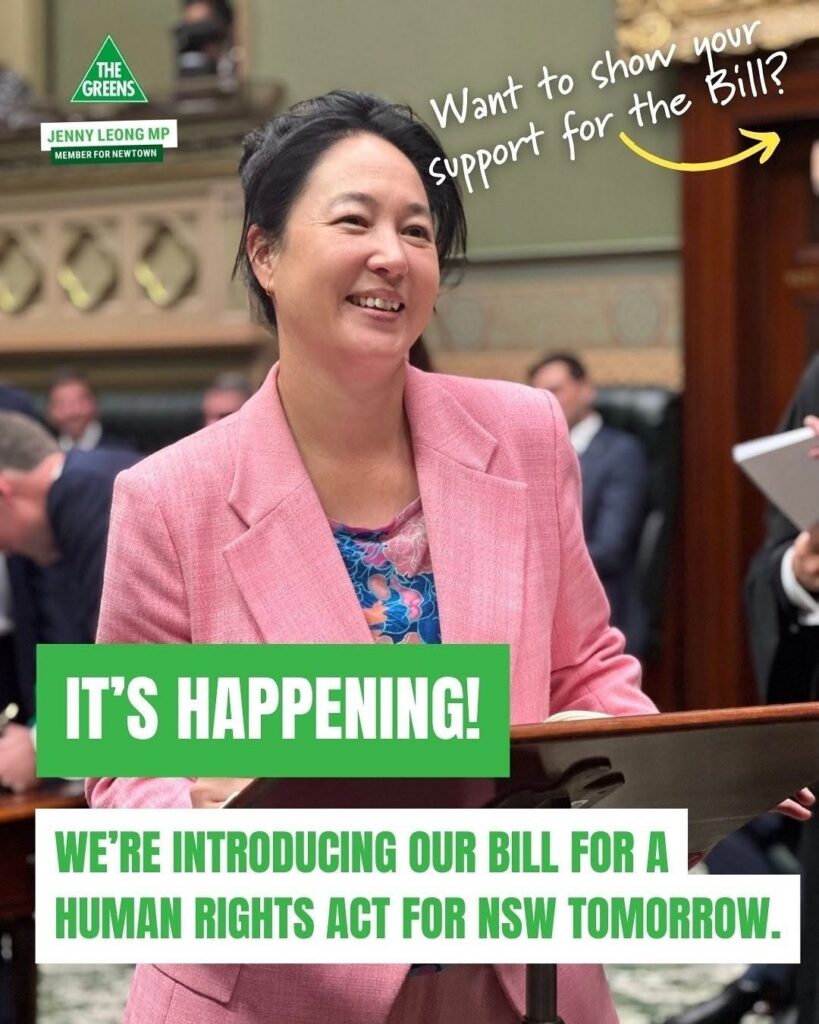
The Bill was introduced by the Greens Member for Newtown, Jenny Leong, to protect, respect and promote human rights in NSW.
‘The Committee understands there is a lot of public interest in the Bill and we will be looking closely at the proposed changes to understand how they would operate. As the Bill has implications for the rights of all NSW residents, it’s important that we hear from a range of stakeholders.’
First print
According to the first print of the Bill, its objectives are fourfold. The first object is to recognise that human rights apply from the time an individual is born and are universal, indivisible and interdependent, and interrelated.
“Human rights are essential in a democratic and inclusive society that respects the rule of law, human dignity, equality and freedom,” the Bill states, and then goes on to sat that “human rights belong to all people without discrimination and the diversity of the people of Australia enhances our community.”
If the Bill were made law in NSW it would assure that human rights could only be limited “after careful consideration and any limitation must only be done in a way that may be justified in a free and democratic society based on human dignity, equality, freedom and the rule of law.”
Such a law would also enshrine “the fundamental importance of the right to self-determination of all peoples, by virtue of which they freely determine their political status and pursue their economic, social and cultural development”.
Powers
Questions about the application and interpretation of the Act would be referred to the NSW Human Rights Commission, which would be established under the Act. That Commission and the NSW Attorney General would also be able to be parties to matters related to the Act before the courts.
A NSW Human Rights Act would set out avenues “available to individuals and representative applicants affected by a public authority acting, or proposing to act, in a way that is unlawful under the proposed division” including lodging a complaint with the Commission, bringing proceedings before the Civil and Administrative Tribunal or the Supreme Court.
The NSW Parliament would also have a Parliamentary Joint Committee on Human Rights if the Bill becomes law. The NSW Ombudsman, the Independent Commission Against Corruption (ICAC) and the Anti-Discrimination Board would be able to refer complaints to the Human Rights Commission.
Rights spelled out
Division 2 of the Bill sets out exactly what is meant by ‘human rights’ – it would enshrine such human rights as:
- Recognition and equality before the law and freedom from discrimination
- Right to life from the time of birth,
- Prohibition of torture, and cruel, inhuman or degrading treatment or punishment,
- Cultural, spiritual, political, social and economic rights of First Nations People,
- Relating to the protection of children,
- Relating to the protection of families,
- Privacy and reputation,
- Freedom of movement,
- Freedom of thought, conscience and religion,
- Peaceful assembly and freedom of association,
- Freedom of opinion and expression,
- Right to take part in public life,
- Liberty and security of the individual,
- Humane treatment when deprived of liberty,
- Children in criminal process,
- Fair hearing,
- Criminal proceedings,
- Victims of crime,
- Dignified treatment,
- Not to be tried or punished more than once,
- Prohibition of retrospective criminal laws,
- Compensation for wrongful conviction,
- Prohibition of slavery and freedom from forced work,
- Rights to culture, education, health,
- Adequate standard of living and housing,
- Work and other work-related rights,
- Social security,
- Property, and
- A healthy environment.
Public authorities
Public authorities would be required to include information about human rights in their annual reports if the Bill were to become law.
It would be unlawful, if the Act became law, for public authorities to “act or make a decision in a way … not compatible with human rights”. In making a decision public authorities would have to “give proper consideration” to human rights relevant to the decision.
This would include an obligation to identify human rights that may be affected by the decision, and considering whether the decision would be compatible with human rights.
The participation of First Nations peoples, children, people with disabilities, women and girls, older people, LGBTIQA+ people, victim survivors, would need to be ensured in decisions that directly or disproportionately affected such peoples.
Leong speech
Greens Member for Newtown, Jenny Leong, called a Human Rights Act a “tool to ensure that dignity and respect for everyone in our communities is at the heart of the decisions that members of Parliament and the government of the day make on behalf of the people of NSW,” at the outset of her second reading speech in the state’s Legislative Assembly last year.
“At a time when everyone is feeling the burden of divisions, local and global challenges, and financial, societal and environmental pressures, the bill seeks to do something in the interests of all people in this State: to unite and connect us, to raise the standard, to aspire to ensure dignity, respect and justice for all,” she said.
“A human rights Act brings together all our rights in one place, and requires public officials to respect them. Any laws introduced in this place will need to have regard to those rights.” Ms Leong said the Bill was drafted in close consultation with human rights experts, including some members of the Human Rights for NSW alliance, which is made up of more than 102 organisations.
“The foundations on which this bill stands were laid nearly 80 years ago, when the United Nations General Assembly voted to establish the Universal Declaration of Human Rights,” she acknowledged.
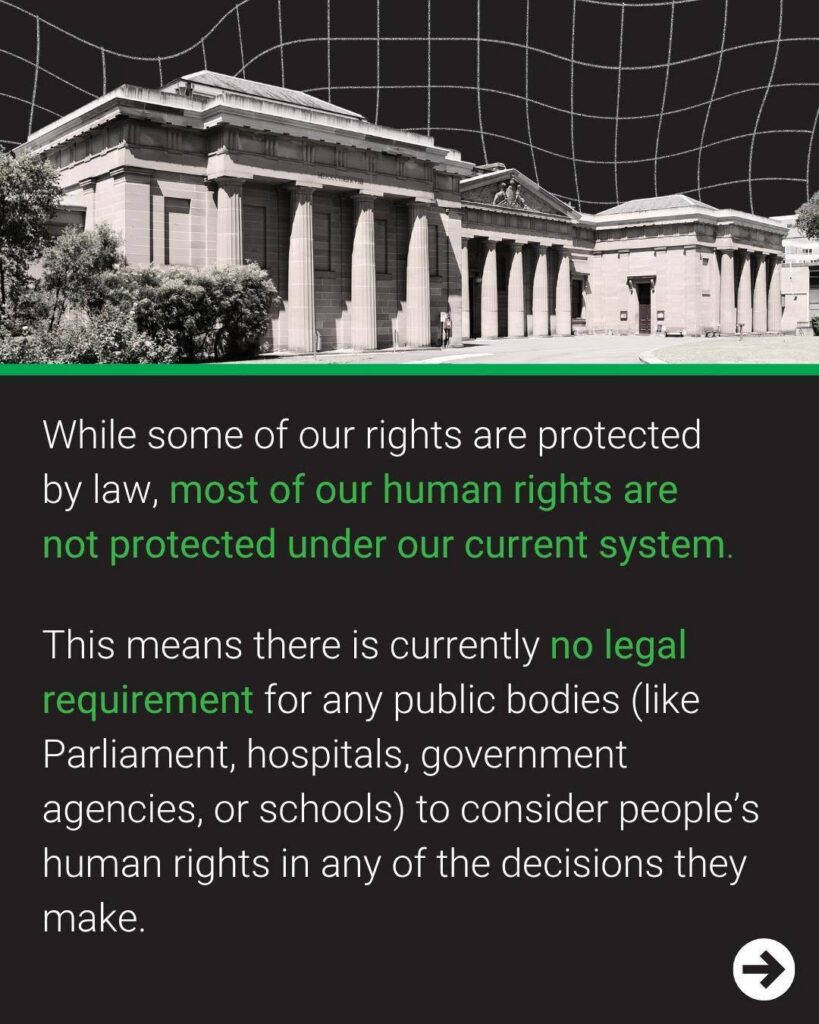
“Every day those working in public services—our hospitals, our transport system, our schools and TAFEs, our aged-care and youth services, our emergency services—are making administrative decisions and acting in ways that can have significant and lasting consequences for people’s lives.
“Yet at present there is absolutely no requirement for any of those making the decisions, developing the policies, implementing the programs or assisting with inquiries over the counter at Service NSW to even consider the impact their actions will have on the rights of the people of this State. A human rights Act will change that.”
Ms Leong pointed out that the 2023 NSW Labor platform stated that it supported “a community consultation into the introduction of further legislation to better protect the human rights of NSW residents when law is interpreted and applied”.
Community campaign
The Human Rights Act for NSW – an Alliance of more than 120 legal and community organisations, religious bodies and trade unions – said it had spent years campaigning for an inquiry into the introduction of a Human Rights Act for NSW.
According to the alliance, NSW has fallen significantly behind comparable jurisdictions when it comes to legally protecting fundamental rights.
Victoria, the Australian Capital Territory and Queensland have enacted Human Rights Acts. Comparable democracies – Canada, New Zealand, the UK – also have well developed local Human Rights Acts.
“The absence of a Human Rights Act in NSW currently leaves residents with some of the weakest legal protection of their human rights anywhere in the Western democratic world.
“This inquiry gives NSW the chance to identify gaps in existing rights protections, learn from other jurisdictions and put in place a law that protects all of NSW communities- no matter their background, identity or location.
“A Human Rights Act would set certain rights in legislative stone, meaning the government would have to check its legislation does not unreasonably impede those rights before it passes laws and public authorities would have to act consistently with those rights when making decisions. It would also provide people in NSW with pathways to seek just and practical solutions if their human rights are breached.
Kerry Weste, Chair of the Human Rights Act Alliance and Vice President at Australian Lawyers for Human Rights, said:“We commend the Parliament for establishing this Inquiry to examine how we can improve human rights protections across our state. For people in NSW basic rights remain largely unprotected under existing legislation, leaving us lagging seriously behind other jurisdictions.
“This consultation, with the entire NSW community, offers us a chance to come together and have a very unifying conversation about returning dignity and power to everyday people, and helping government officials to make fair and caring decisions. It will help us face big challenges like the cost of living crisis, housing crisis, domestic violence, equitable timely access to healthcare and inclusive education for all children.”
Ask your local NSW MP or MLC if they will support the adoption of a Human Rights Act for NSW.
Find out more about the community campaign here https://humanrightsfornsw.org/
The full Human Rights Bill 2025 can be found here https://www.parliament.nsw.gov.au/bills/Pages/bill-details.aspx?pk=18724
Information about the Parliamentary Inquiry can be found here https://www.parliament.nsw.gov.au/committees/inquiries/Pages/inquiry-details.aspx?pk=3183
Jenny Leong’s full second reading speech can be found here https://www.parliament.nsw.gov.au/Hansard/Pages/HansardResult.aspx#/docid/HANSARD-1323879322-158764/link/107